
Conference Report: Society of Philosophy of Technology (SPT) 2025 Conference at the Technical University of Eindhoven in the Netherlands – ‘The Intimate Technological Revolution’
June 25th to 28th I attended the Society of Philosophy of Technology (SPT) 2025 conference at the Technical University of Eindhoven in the Netherlands. The theme for this year’s conference was ‘The Intimate Technological Revolution’ and the many talks and panels presented all centred around the philosophy and ethics of technology grounded in both analytical and continental traditions, and Science and Technology Studies (STS). This ranged from the various uses and dangers of AI and facial recognition technologies, big data, AI and diagnostic tools, technologies for human wellbeing, the environment and technology, and many more - Llona Kavege
June 25th to 28th I attended the Society of Philosophy of Technology (SPT) 2025 conference at the Technical University of Eindhoven in the Netherlands. The theme for this year’s conference was ‘The Intimate Technological Revolution’ and the many talks and panels presented all centred around the philosophy and ethics of technology grounded in both analytical and continental traditions, and Science and Technology Studies (STS). This ranged from the various uses and dangers of AI and facial recognition technologies, big data, AI and diagnostic tools, technologies for human wellbeing, the environment and technology, and many more.
This year, I presented some ideas of a work in progress bioethics paper where I bring technological developments in stem cell-based embryo models and ectogestating technologies (commonly known as artificial wombs) to highlight the convergence argument present in some bioethics literature [as coined and outlined by Teresa Baron (2025)] and argue that these developments unwittingly further a containment view of pregnancy that could in turn lead to research trajectories with negative implications for women and reproductive justice.
Key insights derived from the conference include novel approach and perspectives to technologies and technological assessment/ethical evaluations. A core tenet of philosophy of technology and STS and is that technology is non-neutral. Therefore, technologies should not be regarded as passive objects but rather as mediators of the human experience of the world. A technology can be built in with a specific script and intentionality that inform its design and how we come to relate and engage with the technology as well as how it co-shapes how we engage and relate with the world. This explains how political ideology, beliefs, and values can be coded into very tangible technologies to further certain agendas, for example adding arms rest to benches in parks may seem like a comfort addition for passer bys, however they have also been introduced to prevent rough sleepers from using them to lie down. Moreover, this design has been critiqued as hostile by several scholars, including a keynote speaker at the conference.
This approach to technologies is particularly relevant for ethics because it forces us to rethink moral agency solely from a human standpoint and makes ethics a human-technology relation affair. In addition, this is particularly interesting and under-explored in bioethics. I was able to meet Inmaculada de Melo Martin who presented at the conference on new reprogenetic technologies and how they would transform the landscape of fertility, family creation, and particularly how the making of these technologies’ challenges traditional notions of informed consent. Some other presentations also approached the question of synthetic biology and how these entities could be reckoned with in the light of more relational perspectives of human technology-relations.
Overall, topics addressed and the methods of philosophy of technology furthered my interest and convictions that these perspectives and methodologies could positively contribute to and supplement bioethics scholarship. Bioethics often relies on technology assessment that take an old-fashioned principle-based approach or assesses outcomes based on cost-benefit analysis. This does not provide enough nuance at times and fails to illustrate how some technological developments do not just lead to some outcomes but that they can carry moral assumptions and co-shape our moral judgement as well as disrupt how we conceive and engage with ethics and morality. I am grateful to the IME for funding my conference feeds and travel and I look forward to more cross-disciplinary exchange and to drawing from these insights to improve discussions and the impact of bioethics especially regarding biotechnologies and reproductive technologies.
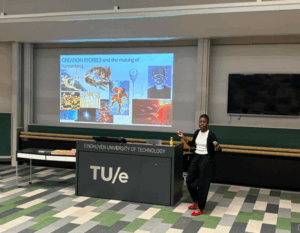
Llona Kavege presenting at SPT 2025 at TU/e in the Netherlands